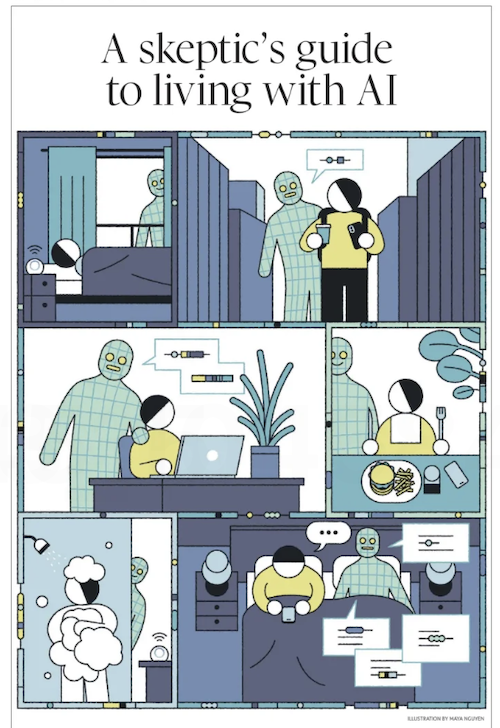
A skeptic’s guide to AI
The hype around AI is real – and so are the warnings
From your search engine to your doctor’s office, your kid’s homework to your latest office training, artificial intelligence is here, there and everywhere.
Canadians are trying to adapt at home and at work. According to Statistics Canada data released in July, one in three workers say they’ve used generative AI tools as part of their job, most on a daily or weekly basis.
But not everyone is sold on the technology.
A survey published by the Angus Reid Institute in June found that while AI use and exposure is exploding in our daily lives, “Canadians are more likely to view AI with skepticism than enthusiasm.” Many worry it will undercut critical thinking or we’ll lose the ability to tell the difference between real and AI-generated content, among other concerns.
In the meantime, some AI experts continue to sound alarm bells about the technology’s potential to get out of control, saying companies are more focused on the race to develop new capabilities than on safety.
Earlier this summer, we asked six Canadian thought leaders in the field for their tips, hopes and perspective on this sea change in how we live and work.
Elena Yunusov, Founder and executive director of the Human Feedback Foundation, a non-profit that advocates for the transparency of AI
When and why did you first embrace AI?
I didn’t think I had much use for artificial intelligence in my daily life. AI was something researchers did, and I’m a little technical, but not that technical. Then ChatGPT changed everything. I was sitting in an airport when it launched and my flight was delayed by seven hours. I talked to ChatGPT the whole time and was shocked at how human it seemed. Just like dial-up internet was once mind-blowing, ChatGPT blew my mind. It was magical.
How do you use AI the most?
I don’t think I could run an organization without AI, which is a navigator for me. At work, it’s like an adviser on command: I bounce ideas off it, I apply for grants, it does design and copy. Right now it’s helping move our site from WordPress to code-based. It’s a Swiss Army knife of a tool.
For fun, I love to play with and explore translations. I speak English, Russian, Ukrainian, Hebrew and some Spanish and French. I love following global news in a multilingual way, because things are covered differently in different languages and perspectives. This is true of AI as well. If I ask the same question in Russian, I get a different answer.
What would you never use AI for?
I never use it for mental-health support. That’s my red line. I don’t think the technology or the guardrails are there, and it’s dangerous in my opinion. It’s the most human technology we’ve ever had, but I don’t think we should be confusing it with human beings. So if and when times get tough, I never go to ChatGPT and cry into the chat window. I turn to people for support.
Anatoliy Gruzd, Professor of information technology management at Toronto Metropolitan University
How should an AI newbie get started?
The question is not where to begin, because even though you might not intentionally use AI, you probably still use AI every day. Every time you use Google, every time you book a hotel or an Airbnb, that’s AI. You’re just one click away, and you might not even realize it’s happening.
The good thing is a chat conversation is actually linked out to the sources. I appreciate this. You can take a little time to see where the information came from.
You can also opt out from sharing your chat data for training purposes. Whether you’re using a free version like ChatGPT or a subscription-based model like Gemini, check your privacy settings. If you allow them to use everything you say, your data will be on the server long after you close the browser.
How will AI change our lives the most?
We used to be more critical about how we consumed information because we had to be. If we were looking for an answer, we would use a search engine. Even though most people won’t go beyond the second page of results, at least you knew they were there. Inevitably, you were forced to cross-check information.
With AI, you just get a summary that looks a whole lot like fact. You don’t know the source of that information or whether it’s biased, which it probably is. For high-stake scenarios, like election-related information, AI may give you a skewed response towards a left- or right-leaning point of view. It could directly impact how you view a particular political party or candidate, which may influence how you vote.
What would you never use AI for?
As somebody who’s been closing on a house, I was reading through a lot of material from the bank and the lawyer. I found it useful to use an AI assistant to explain some of the terminology.
At the same time, when it comes to legal aspects and jurisdictions, I know that models tend to be trained on worldwide data. I don’t know how well it applies to Ontario, where I am. The model is not aware of new developments in specific legal proceedings. Much like with a contractor, I might use AI to look up things in advance so I know what to expect, but I’m still going to hire a professional.
Lai-Tze Fan, Canada Research Chair in technology and social change; associate professor, University of Waterloo
How do you use AI most in your daily life?
I still use paper and pen for pretty much everything. If I’m writing multiple papers or have multiple projects at once, I keep a log of my activities and tasks in a large language-based chat model. Instead of having to look through all my notes of what happened and the memory of my research, I just ask it, what was I doing last? What did I say I need to do next? It’s an interactive externalized memory for me.
How would you never use AI?
So many ways! I’d never take a photo of a mole and ask if it looks cancerous. I wouldn’t use commercialized AI to outsource major decision-making. Mostly I would never use it to replace a personal relationship. It’s not a person. I’ve worked on this quite a lot, especially with early AI assistants that used scripts instead of machine learning, which learn from you and spit back what you want to hear. It’s designed to appease you, and for some people it’s easy to want that as opposed to dealing with real humans.
What do you hope AI will never change?
That we continue to interact with each other and enjoy each other’s company, and appreciate the things that make us human. That could be creativity, emotional connection, exchanging ideas, building friendships and relationships.
I hope we don’t lose the drive to really learn to do something, like putting the 10,000 hours into becoming a master or 12 hours to paint a painting or the two years it might take to write a novel. That’s all a lot of work, and it’s hard and sometimes not comfortable, but you don’t get the reward if you don’t do the work. I sound super old school right now, but it’s true.
Craig Silverman, Investigative journalist and co-founder of Indicator, a newsletter and website that exposes digital deception
How do you use AI the most?
As somebody engaged in investigative reporting and also in training other people on how to use digital tools and techniques for investigative reporting, AI is invaluable to assist with some of my repetitive tasks. If I have a video in a language I don’t understand, I use AI for a quick translation and summary. If I have a large number of documents and I want metadata from these documents, AI can quickly run a check for me.
But the idea of handing over the writing process to AI is not appealing. I use AI to gather information, but I don’t hand over the thinking process because it doesn’t do it as well as I do, and I get the sense I’m atrophying my skills. You still have to choose to do the hard things or you won’t grow and advance.
How should an AI newbie get started?
A good starting point is to think about repetitive or time-consuming daily tasks that could be sped up or made more efficient. I have a ton of Google alerts and newsletters I subscribe to, so I have AI produce a daily digest for me to quickly scan. Anything particularly interesting though, I’ll go back to manually review.
Thinking of AI in terms of “small wins” is a good way to do it. Do not start handing over the most important tasks in your life, whether personally or professionally.
What do you hope AI will never change?
I’m not interested in interacting with 100-per-cent synthetic identities, information and content, so I hope we never lose the imperfectness that is part of human existence. I hope we don’t end up with a perfectly glossy and produced information environment coming from sources unknown, expressed in robotic voices.
I hope we manage to keep some of the imperfections that are part of human existence while using this technology to address problems to hopefully improve the world overall. I hope we don’t lose the human touch.
Cam Linke, Chief executive officer of Amii (the Alberta Machine Intelligence Institute), part of the Pan-Canadian Artificial Intelligence Strategy devoted to research and innovation
When and why did you first embrace AI?
I’ve been with Amii for over 10 years now, where I’ve been around researchers who’ve been studying AI since before I was born, so there have been multiple moments – like the ChatGPT moment – that felt like everything suddenly changed. Around 2017, it was Google DeepMind, and a few years before that, it was ImageNet. Though AI might feel like it arrived in a moment, it actually was a series of moments that happened more slowly than you might think.
How do you use AI the most?
I love AI for all the small ways it helps me. Maybe I’m dealing with a leak or I need to fix something. Maybe I’m travelling and need to know how to unlock my suitcase or translate a conversation or understand a parking sign. I recently used AI to teach me to replace my own windshield wipers and it was so easy. If you would have told me five years ago I could have done all this it would feel like magic.
What would you never use AI for?
I caution everybody about not outsourcing your thinking. Synthesizing and interacting with information is super helpful, but don’t assume it knows everything or that everything it knows is right. When you look something up, don’t simply get the answer you want and not learn anything. AI should be like a thinking assistant, not something that lets you not use your brain any more. Make sure you’re still thinking for yourself.
Stephanie Dick, Historian of computers, mathematics and AI; assistant professor in the school of communication, Simon Fraser University
When and why did you first embrace AI?:
In 2008, I was working on my PhD at Harvard when I proposed to my committee and supervisor that I wanted to write about the automation of mathematical intelligence and reasoning. I was almost warned off the topic because people thought it sounded esoteric. Did I really want to devote decades of my life to studying this?
By 2022, with the launch of large language models like ChatGPT, things were different. My career changed significantly when everyone suddenly became interested in AI. Understanding how we arrived at this wild moment turned out to be useful, because it actually comes at the end of a long and fascinating history. I try to help people put all this in context.
How should an AI newbie get started?
I like to have my undergraduate students do an exercise where they take the same term, let’s say “Isaac Newton,” and do a search in various places like SFU’s library, the Library of Congress, Google, YouTube and then a large language model. They see just how different the results are, because different information infrastructures prioritize diverse things. They reflect different values and capabilities. As opposed to just indexing what might be the most relevant sites or responses, it’s trying to synthesize information. The exercise can be very enlightening.
What do you hope AI will never change?
I’m nervous about how isolated and isolating it could be to go deeper and deeper in with these technologies. When I look out at the world, I’m worried that we’re not talking to each other enough. We don’t put all of our attention onto the same things often enough. We are becoming ever more siloed in our little worlds.
I hear of people who don’t want to listen to any music except the music that they got AI to create for them; they don’t want to engage with anything except their personalized AI content. I hope we won’t forget the importance of collective experiences.