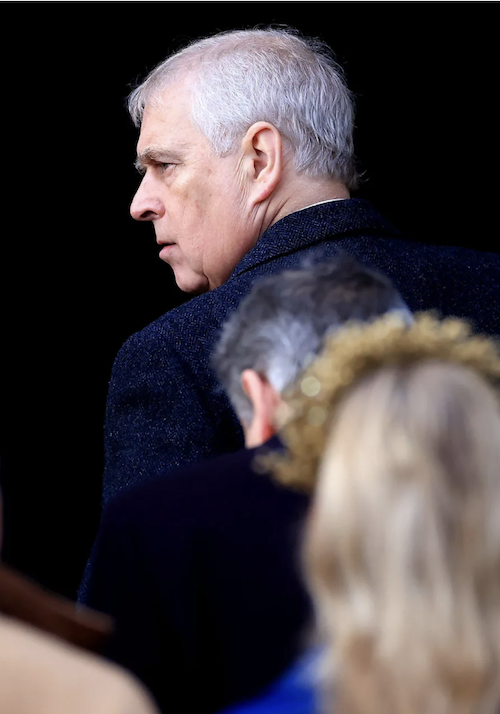
Andrew Mountbatten-Windsor’s Last Christmas at Royal Lodge
Inside the disgraced royal’s imminent eviction, why it might not happen on King Charles’s timeline, and the tony estate where Andrew could be exiled
This Christmas, as the Windsors gather in Norfolk for their usual days-long celebration of carolling, football (that is, soccer), and charades, one notorious name is notably not on the invite list: Andrew Mountbatten-Windsor, the British commoner formerly known as Prince Andrew. As he did last year—and every year since he stepped down from his royal duties in 2019—the late Queen Elizabeth II’s second, and allegedly, favorite son will likely spend his last Christmas at his longtime home, Royal Lodge, alone perhaps, but for his ex-wife and some moving boxes.
In October, when Andrew-accuser Virginia Robert Giuffre’s damning posthumous memoir Nobody’s Girl debuted atop international bestseller lists, King Charles III stripped his younger brother of his title and served an eviction notice heard across the world. “His lease on Royal Lodge has, to date, provided him with legal protection to continue in residence. Formal notice has now been served to surrender the lease and he will move to alternative private accommodation,” read the stern statement from Buckingham Palace.
But this reportedly unemployed 65-year-old’s “alternate private accommodation” probably won’t be a one-bedroom flat. Instead, the ex-duke is expected to move to the king’s private residence, Sandringham—ironically, the very same Norfolk estate that won’t allow his awkward presence at Christmas dinner. That is, if he moves at all. The black sheep brother reportedly isn’t keen to relocate—or even cooperate. Especially when he’s got a deal signed by his mom and tenants’ rights working firmly in his favor. (A spokesperson for the palace did not immediately respond to a request for comment.)
A Rock-Solid Royal Lease
When Elizabeth, the Queen Mother, died in 2002, the then-prince took over his grandmother’s lease at Royal Lodge, where she had resided for 50 long years. As is the way of the royal family, details were negotiated individually and kept private. That is, until recently, when the UK’s Public Accounts Committee publicized Andrew’s so-called “peppercorn deal,” in which a very nominal payment serves to recast a gift as a sale. For the 30-room mansion worth an estimated £30 million ($40.2 million USD), the then-Duke of York paid £1 million upfront and £7.5 million in refurbishments to live at Royal Lodge for 75 years. He was set to pay a symbolic “one peppercorn (if demanded)” annual rent—in other words, almost nothing, until the lease expired in 2078. At that point, Mountbatten-Windsor would be 118 years old.
Until then, Andrew has tenants’ rights just like the rest of us serfs. And provided he pays his peppercorn, he actually cannot be legally evicted—whatever the palace says. Officially, their hard-stop move-out day for Andrew is January 31, per People. Unofficially? “Charles is appearing to act tough, but it’s all smoke and mirrors and window dressing,” says biographer Andrew Lownie, author of Entitled: The Rise and Fall of the House of York. “Behind the scenes, there’s nothing they can do. Andrew can only go voluntarily.”
As such, explains Lownie, the monarchy is “operating like they always do: with a mixture of pressure and patronage.” The strategy works both ways. Mountbatten-Windsor is reportedly “insisting on another big house, an extensive staff, his daughters being protected, and shielded guarantees for when William becomes king—since William wants him out and gone by the time he comes to the throne,” says Lownie. Which prompts another question: Where to? And why? (A spokesperson for Buckingham Palace did not immediately respond to a request for comment.)
Sandringham’s Not-Big-Enough Big House
Short of leaving the country entirely, the furthest possible royal property where “Randy Andy” could be tucked away is the privately owned Sandringham Estate, some 112 miles northeast of the royal family headquarters in London.
Banishment here wouldn’t be all bad. Sandringham boasts 20,000 acres of woods and farmland, worked by tenants in seven villages, plus a country park, nature trail, market garden, fruit farm, and sawmill. Sandringham House proper, a.k.a. the “Big House,” is King Charles’s private home, which at one time had 300 rooms and is used for hosting large family gatherings. It’s just one of at least six royal properties on the grounds—including Anmer Hall, William and Kate’s main residence turned country home (though there is no word on how often they’ll visit if and when their uncle moves in).
Sandringham would be especially fitting for Andrew, given its history of housing royal misbehavers. In Sandringham: The Story of a Royal Home, author Helen Cathcart delves into its sordid history: In 1862, the property was purchased for Queen Victoria’s eldest son, Prince of Wales Albert Edward, who was widely known by his own Randy-Andy-esque nickname, “Dirty Bertie.” Albert had an insatiable appetite for fine food and drink, gambling, women, and brothels. (In his preferred Paris bordello, the insatiable monarch’s infamous “love chair”—a customized piece of “erotic furniture” that regularly makes the rounds on social media—allowed the overweight ruler to have sex with two women simultaneously.)
Upon Albert Edward’s marriage at the age of 21, Sandringham was deemed “sufficiently remote from the distractions and temptations of London,” wrote late author John Matson in Sandringham Days. The royal family believed it might help encourage the heir to settle down. It didn’t work.
The prince and his new wife, Alexandra, were surprisingly well-suited. Both loved a good party, filling Sandringham to the brim with guests at lavish, days-long, debauchery-filled fêtes. Even 29 bedrooms weren’t enough. “There rarely seemed sufficient houseroom to offer hospitality as full and unfettered as the royal host and hostess desired,” notes Cathcart. Within just a few years, the couple began a major renovation of the property.
The All-Boys-Club to Spite Mean Mom
By 1870, Sandringham’s makeover was well underway, always with luxury and indulgence in mind. Cathcart describes an opulent Mar-a-Lago-esque decor scheme that included glistening chandeliers, bronze statues of naiads, and painted cherubs on the ceilings.
Queen Victoria funded the renovations on top of the property’s original £220,000 price tag (some $10 million USD today), widely considered exorbitant, especially considering she visited the place just twice in 40 years. The “Widow of Windsor” partially blamed her beloved husband’s death on their wayward eldest son, whose ongoing celebrations served as a stark contrast to “the melancholy of Windsor,” writes Cathcart. While the queen grieved excessively and indefinitely in London, Sandringham was a mere two-hour train ride away for her subjects and family, who’d had enough mourning and wanted a spot where they could comfortably let loose.
In 1883, Albert Edward added a so-called “Bachelor’s Wing” to Sandringham, complete with a billiard room and bowling alley. He also built a matching “Bachelor’s Cottage” less than a mile away, where male guests could go do whatever men do while their wives slept in the main building. This humble abode eventually became the starter home for Albert Edward and Alexandra’s troubled oldest son, Albert Victor—the controversial Duke of Clarence, who, according to the historical record, was rumored to be dim-witted, homosexual, perverse, syphilitic, and/or Jack the Ripper.
Five weeks before his planned wedding, however, the duke contracted influenza and died. Local lore says his ghost still haunts Sandringham.
An Unlikely Roommate in Very Close Quarters
Desperately in need of a rebrand, Sandringham’s Bachelor’s Cottage was renamed “York Cottage” when it was passed along to George—Prince Albert’s next eldest son, and new Duke of York. However, seeing this name on a plaque might be bittersweet for Mountbatten-Windsor, who lost his title as Duke of York in October. His ex-wife, Sarah Ferguson, is no longer the Duchess of York, either—but at least for the moment, she still resides at Royal Lodge with the man she divorced almost 30 years ago.
Theirs is a roommate situation unlike most. “She has her own little self-contained wing,” says Lownie, “so they don’t even need to see each other if they don’t want to.” Until recently, Andrew and Ferguson mostly did want to see each other, earning a reputation as the “happiest divorced couple in the world”—they’re “divorced to each other, not from each other,” Ferguson told The Telegraph in 2021. (The magazine has since changed its tune; “Hell hath no fury like an ex-Duchess scorned,” reads a newer headline.)
If Andrew gets banished to Sandringham, will Fergie go with him? “No one knows, including, I think, Fergie herself,” says Lownie. Should she stand by her man, Ferguson will continue to enjoy free rent and ample staff, albeit far pared down from what the pair has at Royal Lodge. Should she finally extricate herself from Andrew, Lownie sees a few distinct possibilities: “She could go to Switzerland and become a tax exile, or Portugal to live with her daughter, or come to the States to try again to reinvent herself.”
Any and all of the above, however, will require funds that she’ll have to earn on her own. Ferguson’s money-making endeavors over the years have varied: She’s been an author, memoirist, television and podcast host, digital NFT artist, and eco-friendly diaper spokesperson. The big bucks might come only from what the monarchy fears most: a tell-all book, Netflix documentary, or bombshell-filled Oprah interview, à la Harry and Meghan.
Bahrain, Bahrain for a Black Sheep?
With or without his ex-wife, daily life at Sandringham for Mountbatten-Windsor would include golf, shooting, riding, and watching television. “In some ways, his life won’t be that different to what it is now,” says Lownie. Even now, the former prince doesn’t shop for himself or frequent local pubs—perhaps a good thing, since some of his would-be Norfolk neighbors have already said that he is unwelcome in their vicinity. (“Tarnished,” and “a real shame” were but a couple of the public opinions quoted by locals, while others have called it “a disgrace.”)
If he’s willing to hole up and hunker down, a Sandringham cottage could be the perfect place to house and hide the former Prince. “Ideally, we’ll never see him, there’ll be no news, and everyone will forget about him,” says Lownie. This would likely please the palace—but it’s a plan that may require Mountbatten-Windsor to demonstrate a miraculous personality change. “This is a man who’s never done anything that he doesn’t have to do,” Lownie says. “He won’t suddenly become a cooperative soul; he’ll fight every inch of the way for what he thinks he deserves.”
It could be that Queen Elizabeth II’s alleged favorite leaves England entirely before lowering himself to live a common life amongst regular folk who hate him—especially since there are other parts of the world still keen to roll out a red carpet for a former royal. Following one last lonely Christmas at Royal Lodge, Andrew could pull the old dine-and-dash and hit the road. “I tend to think he might go abroad, particularly to Bahrain or somewhere in the Middle East,” says Lownie. How he’ll pay his rent upon arrival, however, remains to be seen.