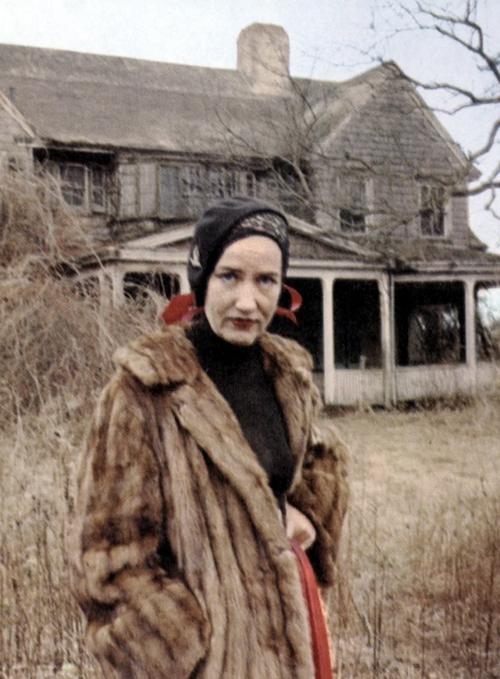
Grey Gardens at 50: Were Little Edie and Big Edie Exploited, or In On the Fun?
An exploitative farce, a second-wave feminist masterpiece, or somehow both at the same time
In the few short months leading up to its wide release, the filmmakers behind Grey Gardens were in a frantic state of damage control. Albert and David Maysles’s now iconic documentary, chronicling the eccentric lives of high-society dropouts “Big” and “Little” Edith Bouvier Beale—Jackie O’s aunt and first cousin—had been courting controversy even before its fall 1975 debut at the New York Film Festival. Critics at its first press screening called the film disgusting, accusing it of exploiting both its oblivious subjects and the beloved former first lady. “You just sloughed off Jackie Kennedy,” reviewer Rex Reed spat at the Maysles brothers as they took the stage after the credits rolled. The Trenton Times gossiped that the film “nearly provoked a fight.”
Grey Gardens was hardly the Maysles’s first foray into controversy, but their latest feature-length film was also their first to feature female subjects as main characters. The filmmakers’ timing—smack-dab in the middle of the women’s lib movement—was either impeccable or atrocious, depending entirely on whom you were asking. Those interpretations hinge upon how a given viewer might interpret the Beales themselves: Were they financially desperate and probably mentally ill victims of patriarchal systems that embarrassed and exploited them? Or were they defiant objectors to societal norms, rightfully cashing in by telling their story of non-conformity on their own terms?
Even now, half a century after Grey Gardens hit mainstream theaters, fans, scholars and critics are no closer to a consensus about the enduring legacy of the film. Let’s review what of the eccentric Beales endures—and what, as Little Edie would say, was merely the best costume for the day.
The seeds of Grey Gardens
In 1960, a young Albert Maysles worked on the JFK campaign film Primary. Tasked specifically with filming Jackie Kennedy, Maysles did that job and more, capturing telling moments—the future first lady nervously fidgeting with her white gloves, for example—that traditionalists felt should have remained private. In the early 60s, explains Georgetown University professor of communications, culture, and technology Matthew Tinkcom, intimate shots like these were part of a new and controversial filmmaking style called “direct cinema” (or, in fancy French terminology, cinéma vérité). “Filmmakers were supposed to be a fly on the wall and no more present than you need to be,” says Tinkcom, author of BFI Film Classics: Grey Gardens.
Jackie was a passionate cinephile who must have appreciated the innovative approach: A full decade later, Lee Radziwill, Jackie’s little sister, remembered the Maysles’s work and chose them to shoot a subsequent personal project about her and Jackie’s society-girl summers in the Hamptons. The Beales were just two of many would-be subjects from the extended Kennedy clan. But as soon as Albert’s camera (with David on sound) captured the pair on film, their charisma stole the spotlight—and Radziwill’s vanity project was shelved. Instead, the brothers decided to tell the Bouvier relatives’ far more interesting tale: a reclusive mother-and-daughter duo living in squalor with dozens of cats and a handful of raccoons. The prim and polished Bouvier sisters were horrified, and forbade the Maysles from using the footage they’d already shot.
The brothers later circled back, sans both Bouvier sisters, to convince the Beales to appear in an experimental film. It wasn’t difficult. “They said, ‘These are our lives. Take them. Record them’,” Albert told The Trenton Times. In return, the Beales were paid a paltry $5,000 each (about $30,000 today) to expose themselves to the world. Like many documentary subjects before them, they hoped for ample royalties on the other side—but as usually happens in cases like this, that money never actually materialized.
A desperately-needed woman’s touch
Over six weeks during the sticky late summer of 1973, Albert and David shot some 70 hours of raw footage showing Big and Little Edie singing and dancing, crafting clothing supposedly coming from Jackie’s hand-me-downs, eating ice cream and canned paté (shared with their cats), and reminiscing over old photographs of their privileged past lives. To make meaning of it all, the Maysles wisely sought three vital female perspectives from editors Susan Froemke, Ellen Hovde, and Muffie Meyer. “It took them three years to edit Grey Gardens into what it became,” says Tinkcom, “and they famously took some liberties.”
The film’s chronology was tweaked to create “a kind of crescendo at the end,” says Tinkcom. Grey Gardens, the estate, had 28 rooms; in the film, we see mother and daughter mostly living in just one of them, often discussing the very feminist notion of choice. “You can’t have your cake and eat it too in this life,” says Little Edie to her mother, who disagrees: “Oh, yes, I did. I had my cake, loved it, masticated it, chewed it and had everything I wanted.” In hopes of becoming a singer, Big Edie separated from her husband. Little Edie had to abandon her dancing aspirations in New York City—and numerous marriage proposals—to care for her own ill mother. Following the heated argument at the film’s apex, Little Edie confesses she “can see now why girls get married.”
Though neither Beale publicly identified as a feminist, the Grey Gardens editors foresaw this piece as a feminist film and edited it accordingly. “It’s very significant that the Maysles brought in three women to give a final shape to the film,” says Joe McElhaney, film professor and author of Contemporary Film Directors: Albert Maysles. McElhaney often screens Grey Gardens for his students, and notices young women responding more and increasingly well to it as the years pass. “There’s something about the Beale women simply living the lives they wanted to live and being completely indifferent to the acceptable roles for women,” he says.
But feminists in the 1970s weren’t yet convinced, even after the Maysles brothers arranged a special “for women only” screening in January 1976 to convince them of the film’s merits. Hosted by Froemke, Hovde and Meyer—and without the Maysles in attendance—an audience of all women gave the film mixed reviews. McElhaney’s book quotes one woman who said she was “sick of seeing myself trapped on the screen…lying around in a pile of shit, with cats all around me. I wanted to go out of this theatre feeling strengthened, not weaker.”
“Devastatingly negative” reviews
The Maysles prepared themselves for harsh reviews when Grey Gardens premiered in February 1976, but they couldn’t have possibly predicted they would be as bad as they were. Village Voice writer Molly Haskell called the Beales “travesties of women” and the film “an ethical and aesthetic abomination.” Film critic Joseph Gelmis described “two women whose lives are infinitely sad and who lose here whatever vestige of dignity their privacy afforded.” Vogue writer Charlotte Curtis described the film as “one of the most exploitative, tasteless and frankly reprehensible films of them all.” (Many decades later, Albert admitted the response was nothing short of devastating.)
But of all the fierce criticisms, the fiercest of all came from New York Times critic Walter Goodman. Personally and palpably angered by the film, Goodman penned 1,800 scathing words beneath the headline “Grey Gardens: Cinéma Verité or sideshow?” arguing the film shouldn’t have been made to begin with. “The sagging flesh, the ludicrous poses, the prized and private recollections strewn about among the tins of cat food—everything is grist for that merciless camera,” he wrote.
Goodman’s take, like many others, obsesses about the Beales’ bodies; Big Edie’s arms are “flabby and creased,” her daughters’ “legs exposed well up the heavy thighs.” McElhaney writes of one blink-and-you’ll-miss-it scene where the 80-year-old Big Edie, wearing her bathing suit, briefly flashes her breasts as she gets out of her chair. He (sarcastically) calls it “the ultimate horrifying transgression,” though Big Edie herself wouldn’t have described it that way. “I’m gonna get naked in a minute so you better watch out,” she says frankly at the film’s beginning. Later, she adds, “I’m not ashamed of anything. Where my body is, is a very precious place.”
The most important #1 fans
Overriding everyone else’s opinions, perhaps, were those of the Beales themselves. Seated between the Maysles in a private box at the film’s premiere, Little Edie revelled in “heavy applause” and “flung two bouquets of flowers down to the audience,” reported the Daily News. Among them were John Lennon and Yoko Ono, Broadway stars Phyllis Newman and Adolph Green, and Knicks Hall of Famer Bill Bradley.
By all accounts, the Beales adored both the film and their depiction in it. “I’m delighted about the film,” the elder Beale told Newsday reporters, “It’s the finest thing I’ve ever done.” At a press conference in the city, Little Edie said, “I hate to say it, but I think we’re interesting. We’re artists and we just love to show off.” No question about it, says McElhaney: “these women wanted to be filmed.”
That they weren’t embarrassed in the least, whatever snooty reviewers said, helped to shift the culture toward a more modern conception of celebrity. “Grey Gardens marks a kind of ambivalence and comfort with fame that they embraced in a really uncanny, smart way,” says Tinkcom. “They realized this would make them famous in a way nobody had been before.”
Of course, we’ve since seen the Beales’s particular mode of fame a thousand times—namely on reality TV. Swap “Big and Little Edie” with the Kardashians, Anna Nicole Smith, or Paris Hilton, and it’s easy to see how the discourse around the film evokes a familiar modern discussion about agency, autonomy, exhibitionism, narcissism and commercialization. As Tinkcom notes, the ever-quotable Little Edie might thrive as a modern-day influencer hocking “staunch” merch on Etsy.
From film failure to cult classic
After all its divisive hype, Grey Gardens grossed less than $40,000 (about $250,000 today)—less than ten percent of the reported $500,000 the Maysles spent to make it. “It took years for this film to recover from its first reception and develop the reputation it has now,” says McElhaney. Here, at least the brothers’ timing was unarguably perfect; the release of Grey Gardens and the introduction of VHS tapes were mere months apart.
Original copies of Grey Gardens on VHS are now rare collectors items, but the widespread 1998 “new 35mm print” is the version that sparked the documentary’s resurgence. In April of that year, the New York Film Forum presented a two-week run that found an unforeseen fanbase in gay men—specifically fashion designers. Little Edie became an icon representing ingenuity amidst adversity, largely due to her freethinking fashion sense. Says McElhaney, “Outsiders of any kind might relate very well.”
One by one, marginalized groups slowly adopted Grey Gardens into their closets, screens and stages. For women, a 2009 drama starring Drew Barrymore and Jessica Lange reimagined the Beales backstory. For film buffs, 2017’s That Summer is documentary-behind-the-documentary prequel. For theatre dorks, Grey Gardens the Broadway musical has played everywhere from Brazil to Japan to Australia—where a new production, House of Rot: Grey Gardens, headlines the upcoming summer season. Ironically enough, it seems the reclusive outliers of Grey Gardens fit staunchly into our world.