Lizzie Borden’s Girlfriend
The True Story of an Accused Murderer and the Famous Actress She May Have Loved
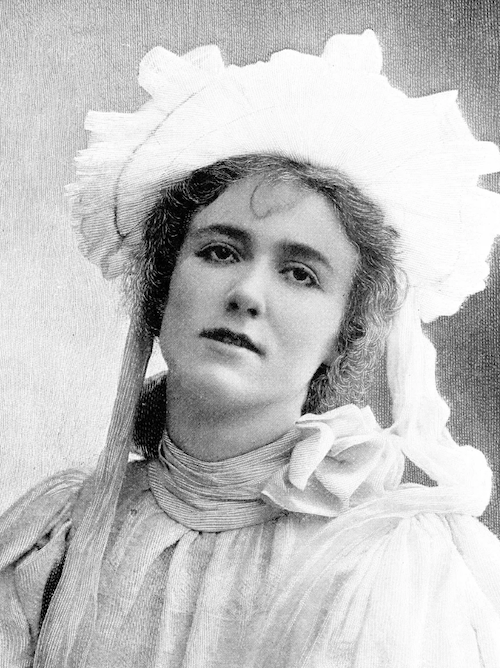
Local lore says Lizzie Borden first saw Nance O’Neil in a production of Macbeth, where the actress played a woman famously driven mad by guilt. While it’s true that O’Neil had portrayed Shakespeare’s fictional Scottish Queen on stages across America and in locales as far-flung as Australia—and that Borden travelled more and further than you might think, using unassuming pseudonyms like “Mary Smith”—it’s more likely that Borden actually spotted O’Neil in Boston in a 1904 production of Hermann Sudermann’s Magda, starring O’Neil as a prodigal daughter who returns to her provincial hometown to confront her tyrannical father.
Borden wasn’t the only patron in the audience to swoon. In a review of the show, The Boston Globe gushed about a “tall, graceful woman with magnificent proportions” and flowing blond hair—“an unusual attribute for a tragedienne”—as well as “eyes that are sympathetic and gentle and powerful and—oh so wonderfully magnetic!” Fanfare declaring 29-year-old O’Neil “Boston’s New Tragic Sensation” must have appealed to Borden—who was at that point arguably Boston’s old tragic sensation. In any case, the acquitted murderer was so captivated that she arranged an introduction to the stage star.
Ryan Murphy takes plenty of creative liberty while imagining the meeting in the latest installment of his Monster anthology, Monster: The Lizzie Borden Story, which premieres on Netflix September 17. On the show, Ella Beatty’s earnest Lizzie Borden meets an egotistical O’Neil (played by Jessica Barden) a dozen years earlier, before the murders and after a sapphic-charged matinée date with her family’s Irish maid (Vicky Krieps). Borden asks for an autograph, then nervously invites the actress to dinner. (“I’ll have beef Wellington,” says O’Neil.)
A scene like this certainly never happened. But we really don’t know much about the strange, short friendship—or more?—borne between “America’s Sarah Bernhardt” and the country’s most infamous accused killer. As Monster premieres, meet the woman said to have stolen—and then broken—Lizzie Borden’s heart.
The Meet-Cute
Though theatergoers may have considered her an overnight sensation, Nance O’Neil had been chasing fame for most of her life. Per her New York Times obituary, O’Neil was born Gertrude Lamson in 1874 to a religious father who sternly opposed her career in showbiz. A teenaged O’Neil nonetheless hustled a role at San Francisco’s Alcazar Theatre by crashing a rehearsal and convincing the director to allow her to join the cast. Alcazar manager Arthur McKee Rankin later took the actress under his managerial wing, repeatedly changing her name until landing on “Nance O’Neil.”
Like many if not most working actresses of the Gilded Age, fame (and money) was always precarious for the undeniably beautiful but questionably talented O’Neil. “Nance had a promising new New York premiere, then went off on a world tour, but she actually bombed in London,” says Dr. Jennifer Jones Cavenaugh, theater professor at the University of Richmond and author of the essay Rebels of Their Sex: Nance O’Neil and Lizzie Borden. Rave reviews from her Boston debut in 1904 no doubt marked a welcome career upswing.
Somewhere in the audience was Lizzie Borden, a passionate playgoer who inevitably enjoyed the privacy dark theaters afforded—giving her the chance to watch rather than being watched. Though she had been acquitted of murder a dozen years earlier, after her trial, Borden was largely ostracized by her ever-disapproving neighbors, who slowly came to realize that the local spinster was almost certainly guilty of a gruesome double murder.
Borden was captivated by O’Neil, writes Michael Martins in the definitive history Parallel Lives. So the lonely woman bravely reached out: “Upon returning to her hotel, [Lizzie] penned a note to the actress expressing her high regard, and asked if she be allowed permission to call on her.” She sent it with a bouquet of flowers, like either a fan or suitor might.
The Honeymoon Phase
While Borden obviously knew about O’Neil, did O’Neil know about Lizzie Borden? Officially, according to a brief 1927 interview in The Sunday Standard O’Neil gave after Borden’s death, she “did not know until some time after their brief friendship began” that Borden had been accused of murdering her father and stepmother. Most historians aren’t buying that for a second. “I don’t think that’s even possible,” says Cavenaugh. “Nance was a smart lady.”
Whether she knew of her visitor’s notoriety or not, O’Neil invited her keen caller backstage. For reasons biographers still can’t quite understand, the gorgeous and famous 29-year-old O’Neil liked frumpy and infamous almost-44-year-old Borden enough to strike up an unlikely friendship that quickly became close.
Just as Monster surmises, Borden surely invited O’Neil to Maplecroft—the imposing 7-bedroom Queen Anne mansion the Borden sisters bought with their ample inheritance. O’Neil later stayed there when “ill from overwork,” a vintage version of the modern-day celebrity claiming “exhaustion”—so Borden could dutifully nurse her back to health. In May 1904, with Lizzie’s help on a downpayment, O’Neil bought a nearby farm property where the two friends could vacation together. And by June, the actress had gifted Borden an expensive book of poetry dedicated “for my dear Lizbeth with love from Daphne.” (Yes, these just-friends used private pet-names.)
Whether the women were simply extra close platonic friends or obviously lesbians depends entirely on who you ask. “I’d say they’re definitely romantic, but maybe not sexual,” says The Trial of Lizzie Borden author Cara Robertson. Others aren’t so sure: “I could certainly see it,” says Cavenaugh, who’s quick to add that the nature of their relationship doesn’t really matter anyhow. “Whether they were or weren’t lesbians, what’s important is that people thought they were.”
A big party with all their “friends”
For years, local newspapers like The Fall River Daily Globe were a thorn in Borden’s side. They reported gleefully on Borden’s every outing and sighting and inappropriate ensemble; while her elder sister Emma always wore conventional mourning black to honor their deceased father, Lizzie never wore black in seeming defiance. The paper reported two (false) rumors of an impending engagement, including one particularly nonsensical story claiming that Borden was going to marry a member of her jury. Even the fractured wrist Borden got after falling from a stepladder was deemed sufficiently newsworthy.
So just imagine the media’s excitement when Borden’s carriage was spotted awaiting a famous actress post-performance. “Not only was Miss O’Neil hospitably treated, but her whole company dined at Miss Borden’s table,” The Fall River Herald gossiped. The truth was better than that: Previously a member of the Woman’s Christian Temperance Union, Borden had fallen in with O’Neil’s raucous crew of travelling performers. With her huge home and deep pockets, Borden threw loud, boozy parties that lasted days at a time.
Borden spared no expense to win over her new theater friends. “An orchestra, caterer, hired palm trees, and amenities—the best money could buy—were all lavished on the theater troupe,” writes Rebecca F. Pittman in The History & Haunting of Lizzie Borden. Though it’s not impossible that these new chums had genuine affection for Borden, the cynical take also seems likely. “Here’s this lady of notoriety who’s getting them tons of attention. Plus, she’s spending a small fortune to entertain them,” says Pittman. Financial records prove that some members of the troupe borrowed money from Borden—and never repaid her.
Trouble in Paradise
Borden’s sister and roommate Emma was notably not a fan of Lizzie’s parties. In later years, O’Neil claimed she’d never actually met the eldest Borden, implying that in the two years O’Neil served as Lizzie’s closest friend, Emma didn’t once come out of her bedroom. “It’s reminiscent of the tensions of the original Borden household,” says Robertson—though this time, Emma confided her troubles to the local Reverend. Lizzie had stopped attending his church, since nobody in the congregation would sit near her.
Whatever Emma confessed was sufficiently sinful that the Reverend advised she cut ties with her sister. Perhaps Emma learned (or suspected) that Lizzie had, in fact, murdered their parents with an axe; maybe she discovered that Lizzie and her new best friend were having a sexual relationship. Whatever the impetus, after standing by her sister’s side their entire lives, Emma packed her belongings in June 1905 and moved away forever. The Borden sisters never saw each other again.
As usual, the newspapers speculated freely. “Sisters estranged over Nance O’Neil,” wrote The Call. “Bordens decide on a separation,” read The Daily Item, as “Miss Lizzie Friendly with Nance O’Neil.” In The Evening Standard, “Entertainment of Nance O’Neil too much for [Emma’s] Orthodox ideas.”
But despite the hasty tendency to blame O’Neil, the sisterly estrangement was surely more complicated than that. “Where the friendship with the actress may have been the cause finalis of the falling-out,” reads Parallel Lives, “the problems on French Street were obviously more long-term.”
Ghosted forever
If Lizzie Borden really chose between her sister and Nance O’Neil, she chose poorly. By 1906, O’Neil’s New England tour had come to an end and, as travelling theater troupes do, it was time to move on. Even with her sensational association to Borden, the actress was getting bad reviews, no longer filling theaters and running out of money. With unpaid debts mounting and facing foreclosure on her home, O’Neil declared bankruptcy in May and left for Paris.
“I don’t think there was a fight or a falling out,” says Pittman, “just that she got tired of Lizzie and had got all she could from her and moved on. It makes me really sad.” Scholars tend to sympathize with Borden after the breakup. “O’Neill took advantage of Lizzie, who I think was an easy target,” says Robertson. “Lizzie was enamoured with Nance and very much wanted to be part and parcel of her world,” says Cavenaugh. Ultimately, she was not.
By her own admission, O’Neil was “a poor correspondent.” In her 1927 interview with The Standard, following Borden’s death at 66 from pneumonia, O’Neil downplayed their friendship. By then, O’Neil was in a conventional marriage to British actor Alfred Hickman. The actress described Borden as a “frail, little gentlewoman” with “grey eyes and graying hair” who “seemed utterly lonely.” She maintained the infamous double murder was “never mentioned between us.”
This practiced and press-friendly denial clearly served O’Neil’s needs and narrative; she was transitioning from the stage to motion pictures, distancing herself from any closeness she once shared with the controversial Borden and still desperately chasing the fame she’d always wanted but never got. “Nance O’Neil is someone we probably all would have completely forgotten about had she not briefly intersected with Lizzie Borden,” says Cavenaugh. If eternal fame was O’Neil’s ultimate duplicitous goal, then the last laugh belongs to Borden.